

Most owners treat workers comp for staffing agencies like rent: a number someone hands them once a year that they can complain about but not change.
That’s wrong in a specific and expensive way. Your premium is the output of a formula, and you influence most of the inputs. Owners who understand the formula run comp as a managed cost of goods sold. Owners who don’t find out their rate went up in the same conversation where they learn they no longer have a carrier.
Workers comp for staffing agencies is the second-largest cost in most firms after wages, and unlike wages it isn’t set by the market. It’s set by your class codes, your claims history, and how well you document both.
Here’s how the pricing actually works, what you can change, and where the money leaks.
Why Workers Comp for Staffing Agencies Works Differently
Every employer buys workers’ comp. Staffing firms buy it under conditions almost no other industry faces.
You are the employer of record, so the coverage, the premium, and the claims belong to you. But your employees work at someone else’s facility, under someone else’s supervision, using someone else’s equipment, in conditions you don’t control and often haven’t seen. You own the financial consequences of a work environment you don’t manage.
Three other structural facts compound it. Turnover is high, so you’re constantly onboarding people into unfamiliar workplaces, and new employees are injured at disproportionate rates in every industry that measures it. Volume spikes are normal, so a peak season can double your field headcount in weeks with training quality inevitably slipping. And your payroll spans many different job types, so you’re not managing one exposure, you’re managing a portfolio of them.
Carriers know all of this, which is why staffing is treated as a difficult class of business and why understanding workers comp for staffing agencies as a discipline, rather than a bill, separates firms that scale from firms that get non-renewed.
How Your Premium Is Actually Calculated
Every workers’ comp premium in the country starts from the same structure:
(Payroll ÷ 100) × Class Code Rate × Experience Modifier = Manual Premium
Carriers then apply schedule credits or debits, expense constants, assessments, and state surcharges. But the core is those three inputs.
Work an example. Say you run $2,000,000 of annual payroll in a class code quoted at $6.50 per $100 of payroll, with an experience modifier of 1.00.
- $2,000,000 ÷ 100 = 20,000 units of payroll
- 20,000 × $6.50 = $130,000
- × 1.00 modifier = $130,000 annual premium
Now change one input. With an experience modifier of 1.25, the same payroll in the same class code costs $162,500. Nothing about your business changed except your claims history.
A $32,500 swing on identical revenue is the difference between a good year and a bad one, and it was determined by decisions made 18 to 36 months earlier.
You Don't Have One Rate. You Have Several.
The most common misconception about workers comp for staffing agencies is that a firm has “a rate.”
You don’t. You have a rate for every class code you run payroll in, and in most states your temporary employees are classified by the work they actually perform at the client site rather than lumped under a single staffing code. A warehouse picker, a machine operator, a registered nurse, and your internal recruiter fall into different classifications at very different rates.
Practically, that means four things.
Your blended rate is a weighted average, and your payroll mix moves it. Winning a large account in a higher-rated code raises your effective cost even though no individual rate changed.
Misclassification cuts both ways. Coding higher-hazard work into a lower-rated class understates your premium until the annual audit finds it, at which point you owe the difference as a lump sum. Coding conservatively means you overpay all year. Both are common, both are avoidable.
Job descriptions matter more than job titles. Auditors classify by duties. “Warehouse associate” tells them nothing. Whether that person operates powered equipment, works at height, or handles a blade tells them everything.
Class codes are not uniform nationally. Most states use NCCI classifications, while several, including California, New York, New Jersey and Pennsylvania, maintain their own rating bureaus with their own codes and rules. The same job can carry a different code and a very different rate across state lines.
Get your payroll allocated correctly by code and by state before your audit does it for you.
What Comp Costs by Staffing Vertical
Workers comp for staffing agencies is quoted per $100 of payroll, and rates vary enormously by the work performed. These are directional, not quotes, and your actual rates depend on state, carrier, and loss history.
Clerical and administrative sits at the bottom, often well under a dollar per $100. Exposure is mostly ergonomic, plus auto if anyone drives for work. Comp is a minor line item here.
Professional, IT, finance and engineering are similarly low-rated. The wrinkle is that pay rates are high, so while claims are rare, the indemnity portion of any claim that does occur is larger, because wage replacement scales with the wage.
Light industrial commonly lands in the mid-single digits per $100 and is where most staffing comp dollars are spent. Lifting injuries, struck-by and caught-in incidents, and powered equipment drive frequency.
Healthcare and nurse staffing varies widely by setting. A clinic placement and a skilled nursing facility placement are different exposures entirely. The specific drivers are patient handling injuries, needlesticks and bloodborne pathogen exposure, and workplace violence, which is a recognized and growing risk in healthcare settings. Travel nurse placements add multi-state coverage complexity on top.
Hospitality and food service is moderate, driven by burns, slips, and cuts, with high turnover amplifying frequency.
Construction and skilled trades carries the highest rates, plus certified payroll and prevailing wage obligations on public work and fall protection requirements. Here the binding constraint usually isn’t price, it’s finding a carrier willing to write the class at all.
Drivers and CDL placements combine comp exposure with commercial auto exposure, which is its own difficult market.
The practical takeaway: your vertical strategy is also your insurance strategy. Deciding to move upmarket into a new specialty is a decision about your comp profile, and it should be priced before it’s sold.
Why Light Industrial Is the Hardest Book to Insure
Light industrial deserves its own note, because it’s where most firms concentrate and where workers comp for staffing agencies is hardest to control.
Warehouse associates, machine operators, forklift drivers, production and assembly workers, and distribution center staff work in environments where injuries genuinely happen. Add the industry’s onboarding speed during peak season, supervision by client managers rather than your own, and equipment you didn’t specify or maintain, and you have a frequency problem by design rather than by accident.
That’s why jobsite evaluation matters more in this vertical than anywhere else, and why the accounts you decline do as much for your loss ratio as the safety training you deliver.
The Experience Modifier Is the Part You Control
The single biggest lever in workers comp for staffing agencies is your experience modification rate, the ex-mod or EMR, which compares your actual losses to the losses expected for a firm of your size in your class codes.
- 1.00 means you perform as expected
- Below 1.00 is a credit and you pay less than the manual rate
- Above 1.00 is a debit and you pay more
Three things about the mod that most owners don’t know.
It runs on a lag. The mod typically uses three years of loss data, excluding the most recent year. The claims driving your current pricing happened one to four years ago, and the claim you have this month will affect your premium for years. There is no quick fix, which is precisely why the discipline has to be continuous.
Frequency hurts more than severity. Experience rating formulas weight the first portion of every claim heavily and discount the excess above a threshold, on the theory that many claims reflect your safety practices while one catastrophic claim partly reflects chance. The consequence: three $5,000 strains can damage your mod more than a single $40,000 fracture. Small claims are not small.
Medical-only claims are often discounted. Many states apply a reduction to claims that never become lost-time claims. That one fact is the entire financial argument for a real return-to-work program.
What the Mod is Worth in Cents Per Hour
Owners think in bill rates, so translate it. A field employee at $18 an hour in a class code rated $6.50 per $100 of payroll:
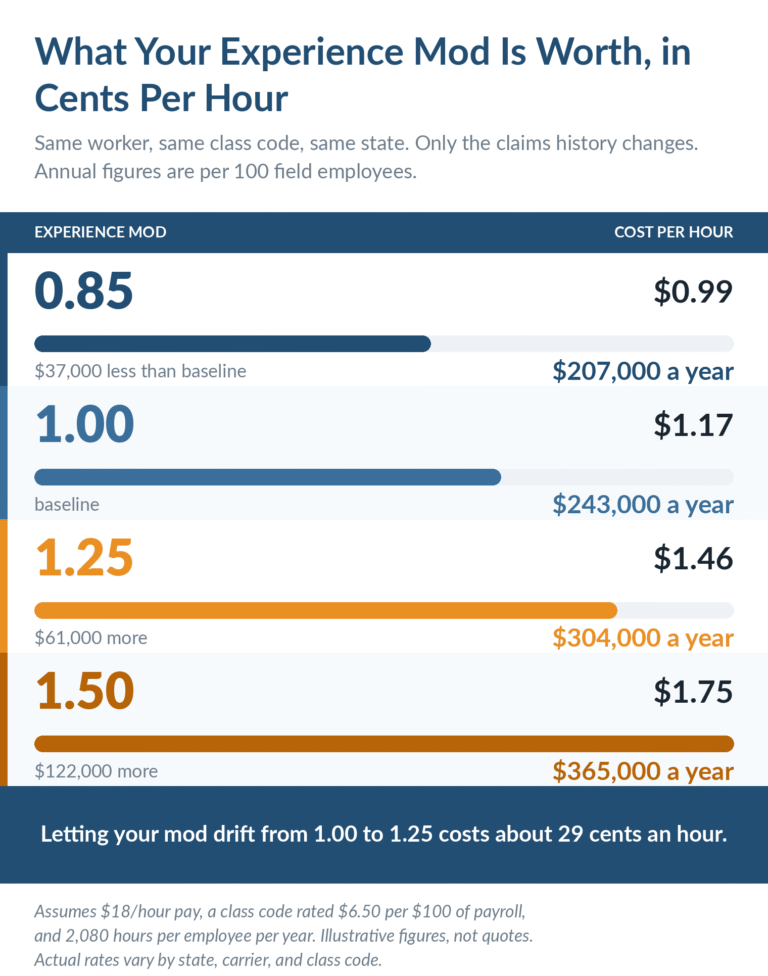
Moving from 1.00 to 1.25 costs about 29 cents per hour, roughly $61,000 a year across 100 full-time field employees. Moving from 1.25 down to 0.85 saves about 47 cents an hour, close to $98,000 on the same headcount.
That’s not an insurance conversation. That’s your margin.
Who Is Liable When a Temp Gets Hurt?
This is the most-searched question about workers comp for staffing agencies, and one of the least clearly answered.
As the employer of record, you generally provide the coverage and your policy responds to the injury. In most states workers’ comp is the exclusive remedy against an employer, meaning the injured worker receives benefits but cannot separately sue you in tort for negligence.
The complication is that your employee has two employers in practice. Many states apply some version of the dual employer or special employer doctrine, which can extend that same tort immunity to your client, since the client functions as a co-employer for injury purposes. Whether it applies, and on what facts, varies significantly by state.
Several contract mechanics sit on top of this, and they belong in every MSA you sign.
Indemnification and hold harmless language allocates responsibility between you and the client. Read which direction it runs and how broadly, because a mutual indemnity and a one-way indemnity are very different documents.
Waiver of subrogation prevents your carrier from pursuing the client to recover what it paid. Clients request them routinely. Your carrier has to agree, and it has a cost.
Alternate employer endorsement extends your policy’s protection to the client for your employees at their site. Also commonly requested.
Certificate of insurance requirements specify the coverage types and limits you must carry. Ask for these during the sales conversation, because discovering a requirement you can’t meet after winning the account is expensive.
One more piece people miss: OSHA recordkeeping. Under OSHA’s guidance on temporary workers, the host employer generally records injuries for temporary workers it supervises day to day, while the host and the staffing agency share responsibility for training and hazard communication. That shared duty is real, and “the client was supervising them” is not a complete defense.
Have counsel review the liability and insurance sections of your client agreements. These terms are negotiable, and they determine whether a single injury becomes a claim or a lawsuit.
Pricing Comp Into Your Bill Rate
Here’s the arithmetic that decides whether an account is profitable, and it’s where workers comp for staffing agencies stops being an insurance topic and becomes a pricing one. Take a placement at $18 per hour, class code rated $6.50 per $100, experience mod 1.15:
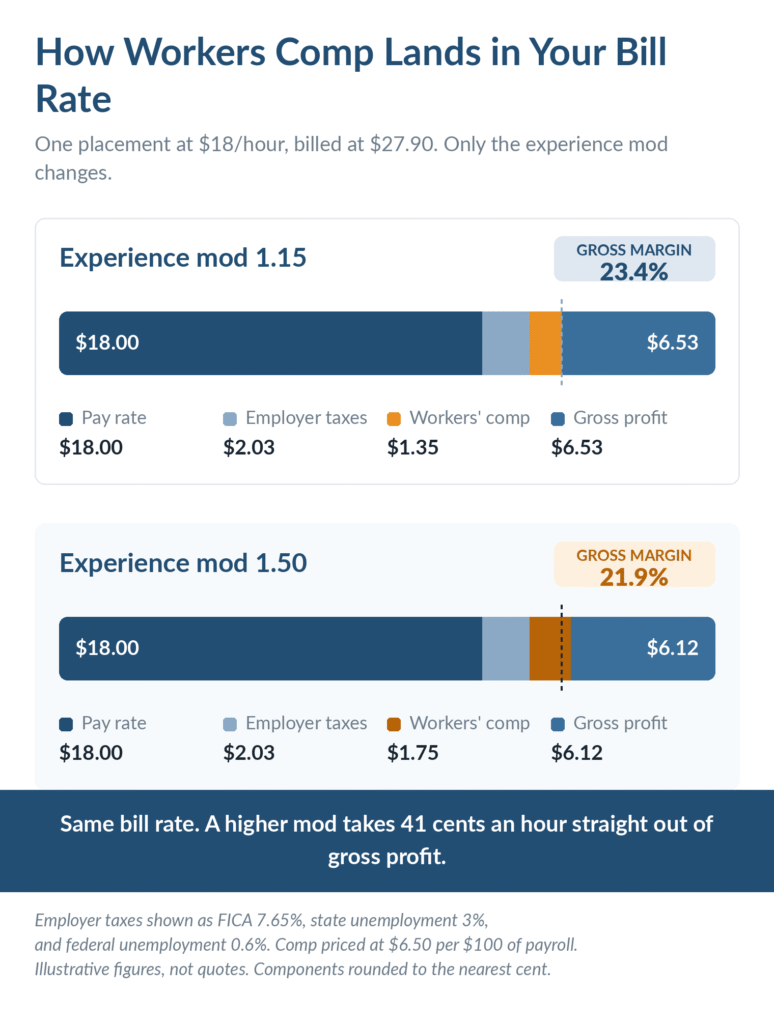
Now let your mod drift to 1.50. Comp becomes $1.75 an hour, loaded cost becomes $21.78, and gross profit falls to $6.12. You gave away 41 cents an hour on every placement, over $85,000 a year across 100 FTEs, without changing a single bill rate.
Two rules follow.
Never quote a bill rate on an assumed comp cost. Get the actual rate for the actual class code in the actual state first. Guessing here is the fastest way to book unprofitable work that looks fine on markup.
Rebuild your rates when your mod changes. A new mod is a change in your cost of goods sold. Firms that reprice stay profitable. Firms that treat markup as fixed absorb it out of margin.
Why Carriers Decline Staffing Firms
Understanding the underwriter’s view is how you get quoted. Carriers treat workers comp for staffing agencies as a hard class of business, for legitimate reasons.
They see high turnover, employees supervised by third parties at sites they can’t inspect, rapid onboarding during peak periods, and a claims frequency profile that reflects all of it. Add a new agency with no loss history and many markets simply decline.
What makes a submission competitive:
- Complete loss runs, typically three to five years, recently valued. Gaps and stale valuations read as concealment.
- Payroll broken out by class code and state, not one total.
- A client list with the actual work performed at each site, including honest disclosure of your highest-hazard accounts.
- A written safety program covering onboarding, PPE, hazard communication, and injury reporting, plus evidence you follow it.
- Jobsite evaluation practices, including examples of accounts you’ve declined on safety grounds.
- A written return-to-work program.
- A named claims process with a 24-hour reporting standard.
Two practical notes. Use a broker who places staffing business specifically rather than a general commercial agent, because market access and submission quality both depend on it. And start renewal 90 to 120 days out. Late submissions get worse pricing, and in a tight market they get no options at all.
The Cash Flow Side Nobody Warns You About
Workers comp for staffing agencies isn’t only an expense line. It’s a cash timing problem, which matters in an industry that already funds payroll weeks before clients pay. If that gap is new to you, our breakdown of Net 30, Net 60 and Net 90 payment terms covers it.
Deposits. Carriers commonly require a deposit at binding, and for a new or higher-risk firm it can be a meaningful percentage of estimated annual premium. That’s cash out before you’ve billed an hour.
How you report payroll. Traditional policies estimate annual payroll and bill installments. Pay-as-you-go or monthly self-reporting charges premium on actual payroll each cycle, aligning cost with revenue and avoiding large true-ups. For a growing firm that alignment is worth real money.
The annual audit. At policy end the carrier reconciles estimated payroll to actual by class code. Grow faster than projected, or misclassify work, and you get a lump-sum bill at the worst possible time. Reforecast mid-term with your carrier and the surprise disappears.
Overtime treatment. In many states the premium portion of overtime, the extra half in time-and-a-half, is excluded from the payroll used to calculate comp premium, but only if your records separate it. Firms that don’t break out overtime pay premium on the full amount. On an overtime-heavy book that’s substantial and entirely avoidable.
Ask your broker about the last two specifically. They’re the two most commonly left on the table.
Claims Management: The First 24 Hours and the Next 90 Days
Since frequency drives your mod and medical-only claims are often discounted, claims handling is the most active part of managing workers comp for staffing agencies. It’s margin protection, not paperwork.
Report within 24 hours. Delayed reporting increases claim cost, litigation likelihood, and duration. Make it a standing rule with clients that injuries are reported to you immediately, and write it into the MSA.
Direct care where you’re permitted to. In states allowing employer-directed care, designated occupational medicine providers who understand return-to-work produce better outcomes than an emergency room. Know your state’s rules on medical control.
Run a real return-to-work program. The highest-return practice available to you. If an injured worker can perform modified duty, the claim may stay medical-only rather than becoming lost-time, and many states discount medical-only claims in the mod calculation. That requires two things arranged in advance: a written light-duty policy, and clients who have agreed to accommodate modified duty. Negotiate that before an injury, not during one.
Stay in contact with the injured worker. Employees who feel abandoned hire attorneys. Employees who hear from their employer weekly generally don’t. This costs nothing.
Review open claims quarterly with your carrier or TPA. Reserves set high and never revisited inflate your mod. Some old claims that should be closed simply haven’t been.
Accounts Worth Declining
The most profitable decision you can make about workers comp for staffing agencies is sometimes to walk away from an account. Treat these as serious warnings:
- Client won’t allow a pre-placement jobsite walkthrough
- Machinery without functioning guarding, or lockout/tagout that exists only on paper
- Work at height, or on equipment, that wasn’t described in the job order
- Client expects workers to operate powered industrial trucks without verifying certification
- Poor OSHA history or recent serious citations
- Refuses to accommodate any modified duty
- Demands broad one-way indemnification while controlling all site conditions
- Bill rate that doesn’t support your actual comp cost for the class code
Each of these converts into claims, and claims convert into a mod that prices you out of accounts you actually want. Declining one bad account is cheaper than the three years of premium it costs you.
Multi-State Complications
Expanding across state lines multiplies the work of managing workers comp for staffing agencies in ways that surprise growing firms.
Four states operate monopolistic state funds, meaning coverage must be purchased from the state rather than a private carrier: North Dakota, Ohio, Washington, and Wyoming. Your national program doesn’t cover those; you need separate arrangements.
Rating bureaus differ. Most states use NCCI. Several, including California, New York, New Jersey and Pennsylvania, use their own, with distinct codes, rules, and mod calculations. A firm can hold different experience mods in different states.
Severity and litigation environments vary widely. California and New York are frequently cited as more difficult for staffing exposure, driven by claim costs, litigation rates, and carrier appetite rather than any single rule.
Coverage must be in force in every state where you place employees, properly listed on the policy, with payroll allocated to the correct state. Placing a worker in a state not scheduled on your policy is a serious gap.
Confirm coverage, class code, rate, and reporting requirements before accepting an order in a new state. Sales teams routinely sell into new geographies faster than operations can get coverage in place.
PEO or Direct Coverage?
Both are legitimate ways to handle workers comp for staffing agencies, and the right answer changes as you grow.
A PEO can be the right answer when you’re new with no loss history, when your claims history makes direct placement difficult, when you operate in states or class codes where carrier appetite is thin, or when you’d rather not build the administrative infrastructure yet. You’re accessing a larger pool and an established carrier relationship, which can be the difference between having coverage and not having it. Get the approved and excluded class codes in writing before you quote a client, because approval is by code and duty, not a blanket yes.
Direct coverage tends to win as you scale. You control the claims process, you capture the benefit of a good loss history directly, your experience mod becomes an asset you own, and the economics usually improve with payroll volume. You also retain full control over billing and client relationships.
Many firms run a hybrid, using a PEO in specific states or verticals while carrying direct coverage elsewhere, and using a separate payroll funding partner throughout. That’s a common and sensible arrangement.
The decision should turn on your size, loss history, state footprint, and how much administrative capacity you want to own. It shouldn’t turn on which structure someone is selling.
What to Do in the Next 90 Days
- Pull your current experience mod and five years of loss runs. Every conversation about workers comp for staffing agencies starts with that number.
- Verify payroll is allocated to the correct class code and state. Fix what isn’t.
- Confirm your payroll records break out overtime premium separately.
- Rebuild your bill rates using actual comp cost per hour, by class code.
- Put a written return-to-work policy in place and get client agreement to accommodate modified duty.
- Set a 24-hour injury reporting standard and write it into your client agreements.
- Review open claims with your carrier or TPA and challenge stale reserves.
- Start renewal 90 to 120 days out with a broker who places staffing business.
The Takeaway
Workers comp for staffing agencies is a managed cost, not a fixed one. The formula is public: payroll, class code rate, experience modifier. You can’t change the state’s rate, but you control which codes your payroll lands in, whether your bill rates reflect your actual cost, how many claims you generate, how fast you report them, and whether an injured worker returns to modified duty instead of becoming a lost-time claim.
The firms that get this right treat comp as an operating discipline with a number attached, and they know that number in cents per hour. The firms that get it wrong find out at renewal, when the mod arrives and the margin is already gone.
Where Madison Resources Fits
Madison Resources provides payroll funding and back-office support to staffing firms, where workers comp for staffing agencies and cash timing are often the two constraints that matter most. We fund payroll against your invoices so wages clear on schedule while clients pay on theirs, and we handle invoicing, cash application, A/R and reporting, which keeps the payroll records clean by class code and state. That documentation is exactly what your carrier and your auditor ask for.
We also maintain relationships with PEO providers and workers’ compensation partners who understand staffing. In certain states and verticals, many of our clients run comp through a PEO structure while continuing to use Madison for payroll funding.
If you’re working through a comp problem, whether that’s pricing, coverage access, or the cash impact of a deposit or an audit, get in touch with our team.
Disclaimer: This article is provided for general educational purposes and does not constitute insurance, legal, or tax advice. Workers’ compensation rates, classification rules, and liability doctrines vary by state and by carrier, and change over time. Illustrative figures are used to explain how pricing works and are not quotes. Consult a licensed insurance professional experienced in staffing, and qualified legal counsel regarding your contracts and obligations.
Ready to start your funding journey? Partner with Madison Resources today [apply here]
Explore our website to find more staffing insights. Madison Resources is the premier payroll funding and back office support partner to the staffing industry. Grow with confidence.
Frequently Asked Questions About Workers Comp for Staffing Agencies
Below are answers to some of the most common questions about Workers Comp for Staffing Agencies.
How Is Workers Comp for Staffing Agencies Calculated?
Payroll divided by 100, multiplied by the rate for each class code, multiplied by your experience modifier. On $2,000,000 of payroll in a code rated $6.50 per $100 with a 1.00 mod, that’s $130,000 before credits, debits, assessments, and expense constants. The formula matters because it identifies exactly which inputs you influence: which class codes your payroll falls into, and your experience modifier.
How Much Does Workers Comp Cost for a Staffing Agency?
It’s quoted per $100 of payroll and depends on state, class code, and loss history. Clerical codes are often well under a dollar per $100. Light industrial commonly falls in the mid-single digits. Construction and skilled trades run considerably higher. On an $18 per hour placement at $6.50 per $100, comp costs about $1.17 per hour before applying your experience modifier. Get quotes for your actual codes rather than working from published ranges.
Why Is Workers Comp for Staffing Agencies More Expensive Than for Other Employers?
Because of the structure. You’re the employer of record, so the premium and claims are yours, but your employees work at client sites under client supervision using client equipment in conditions you don’t control. Add high turnover, rapid onboarding during peak seasons, and a payroll spread across many job types, and carriers price staffing as a harder class of business than a single-location employer with a stable workforce.
What Is an Experience Modification Rate?
It’s the biggest lever you have over workers comp for staffing agencies, and it compares your actual claim losses to the losses expected for a firm of your size in your class codes. A 1.00 is average, below 1.00 earns a credit, above 1.00 applies a debit. It typically uses three years of loss data excluding the most recent year, so it moves slowly in both directions. Moving from 1.00 to 1.25 costs roughly 29 cents per hour on an $18 placement, about $61,000 a year across 100 full-time field employees.
Why Do Small Claims Hurt More Than Big Ones?
Experience rating weights the first portion of each claim heavily and discounts amounts above a threshold, on the reasoning that many small claims reflect your safety practices while one severe claim partly reflects chance. So three $5,000 strains can damage your modifier more than a single $40,000 injury. This is why firms focused only on catastrophic prevention still end up with a poor mod, and why reducing frequency is the highest-return way to lower workers comp for staffing agencies.
Who Is Liable if a Temporary Worker Gets Injured?
As employer of record, your policy generally responds, and in most states workers’ comp is the exclusive remedy against the employer, so the worker receives benefits rather than suing you in tort. Many states also extend that immunity to your client under dual employer or special employer doctrines, since the client functions as a co-employer. Specifics vary by state, and your contract terms on indemnification, waiver of subrogation, and additional insured status allocate the rest. Have counsel review those sections, because they matter as much as the workers comp for staffing agencies policy itself.
Does the Client or the Staffing Agency Record the Injury on the OSHA Log?
Under OSHA’s guidance on temporary workers, the host employer generally records injuries for temporary workers it supervises day to day. That doesn’t remove your obligations, because OSHA treats hazard training and communication as a shared responsibility between the host employer and the staffing agency. Document the training you provide and the site conditions you verified, since “the client supervised them” is not a complete answer to a citation.
What Is a Waiver of Subrogation and Should I Agree to One?
Subrogation is your carrier’s right to recover what it paid on a claim from a third party who caused it, including your client. A waiver gives up that right. Clients request them routinely, and your carrier must agree since it’s their right being waived. It isn’t automatically unreasonable, but it removes a recovery avenue and can affect pricing, so treat it as a negotiated term with a cost rather than boilerplate, since it affects both your recovery rights and your workers comp for staffing agencies pricing.
Are Temporary Employees Classified Under a Single Staffing Class Code?
Generally no, and this is the most misunderstood part of workers comp for staffing agencies. In most states your temporary employees are classified by the work they actually perform at the client’s site, so a warehouse picker, a nurse, and your internal recruiter fall into different codes at different rates. You don’t have one comp rate, you have a weighted blend that shifts as your payroll mix changes. It also means accurate job descriptions matter more than job titles, because auditors classify by duties.
How Does Workers Comp Differ by Staffing Vertical?
Substantially, and vertical is the single biggest driver of what workers comp for staffing agencies costs you. Clerical and professional placements carry the lowest rates, with exposure that’s mostly ergonomic. Light industrial sits in the middle and is where most staffing comp dollars are spent, driven by lifting, struck-by, and equipment incidents. Healthcare varies by setting, with patient handling, needlesticks, and workplace violence as the main drivers. Construction and skilled trades carry the highest rates, and there the constraint is often carrier appetite rather than price. Your vertical strategy is also your insurance strategy.
Is Workers Comp Harder to Get for Light Industrial Staffing?
Generally yes, and it’s the vertical where most firms feel it. Warehouse and manufacturing placements combine real physical exposure with fast onboarding, client supervision, and equipment you didn’t specify or maintain. Carriers price that frequency profile accordingly, and some decline it. Jobsite evaluation before placement, verified equipment certifications, and a willingness to turn down unsafe accounts do more for your loss ratio in light industrial than anywhere else.
What About Workers Comp for Nurse and Healthcare Staffing?
It’s a different exposure rather than simply a higher one. Rates vary considerably between a clinic, a hospital, and a skilled nursing facility. The main drivers are patient handling and lifting injuries, needlestick and bloodborne pathogen exposure, and workplace violence, which is a recognized risk in healthcare settings. Travel placements add multi-state coverage and licensure complexity. Because pay rates are higher, the wage replacement portion of any claim is also larger.
Why Do Carriers Decline Staffing Firms?
High turnover, employees supervised by third parties at sites carriers can’t inspect, fast onboarding during peak periods, and a claim frequency profile that reflects all of it. New agencies with no loss history are hardest to place, because underwriters have nothing to price against. You improve your odds with complete loss runs, payroll detailed by class code and state, honest disclosure of your highest-hazard accounts, a written safety and return-to-work program, and a broker who places staffing business specifically.
What Documents Do I Need for a Workers Comp Quote?
Three to five years of recently valued loss runs, payroll broken out by class code and state, a description of the actual work performed at each client site, your written safety program, injury reporting and return-to-work procedures, prior policy declarations, and your current experience modifier worksheet. Incomplete submissions get worse pricing, and in a tight market they get declined without a quote. Start 90 to 120 days before renewal.
How Can a Staffing Agency Lower Its Workers Comp Costs?
Seven things actually move workers comp for staffing agencies. Reduce claim frequency through jobsite evaluation and real onboarding, report injuries within 24 hours, run a return-to-work program so claims stay medical-only where possible, verify payroll is coded correctly, separate overtime premium in your payroll records, review open claims and challenge stale reserves, and decline accounts whose conditions or bill rates don’t work. Then reprice your bill rates to reflect actual comp cost. The mod moves slowly, so these compound rather than producing immediate savings.
What Is a Return-to-Work Program and Why Does It Matter Financially?
It’s a written process for bringing an injured employee back to modified or light duty while they recover. The financial argument is specific: if a claim never becomes a lost-time claim, many states apply a discount to it in the experience rating calculation, so the same injury does less damage to your modifier. It also shortens claim duration and reduces litigation. It requires a written policy and client agreement to accommodate modified duty, both arranged before an injury occurs.
What Happens at a Workers Comp Audit?
At policy end the carrier reconciles the payroll you estimated against your actual payroll by class code and state, then bills or credits the difference. Two things commonly produce large bills: growing faster than projected, and payroll coded to lower-rated classes than the work supports. Keep records that clearly separate job duties, states, and overtime premium, and reforecast with your carrier mid-term if you’re growing. The audit is where workers comp for staffing agencies most often produces an unplanned bill.
Is Overtime Included in Workers Comp Premium Calculations?
In many states the premium portion of overtime, the extra half in time-and-a-half, is excluded from the payroll used to compute comp premium, but only if your records break it out separately. Firms reporting gross wages without separating overtime pay comp on the full amount. On an overtime-heavy book this is one of the largest avoidable costs in the entire program. Confirm the rule in each state you operate in and fix your payroll reporting.
Should a Staffing Agency Use a PEO for Workers Comp?
It’s reasonable in specific situations, and for some firms it’s the only way to get workers comp for staffing agencies placed at all: you’re new with no loss history, your claims history makes direct coverage hard to place, you operate in states or codes with thin carrier appetite, or you don’t want to build the administrative infrastructure yet. The tradeoffs are cost and less control over claims. Many firms move to direct coverage as payroll volume grows and loss experience improves, because the economics usually favor it and a good experience mod becomes an asset you own. If you use a PEO, get approved and excluded class codes in writing before quoting clients.
Which States Are Hardest for Staffing Workers Comp?
Four states require coverage through a monopolistic state fund rather than a private carrier: North Dakota, Ohio, Washington, and Wyoming, so a national program won’t cover them. California and New York are commonly described as more difficult for staffing exposure because of claim costs, litigation activity, and limited carrier appetite. Several states also use their own rating bureaus rather than NCCI, with different codes and mod calculations, which means your rate and even your experience modifier can differ across state lines.
Do I Need Coverage in Every State Where I Place Employees?
Yes, and the state needs to be properly scheduled on your policy with payroll allocated to it. Placing a worker in a state that isn’t listed is a serious coverage gap, and in monopolistic fund states you need a separate arrangement with the state fund entirely. Confirm coverage, class code, rate, and reporting requirements before accepting an order in a new state, because sales teams routinely sell into new geographies faster than operations can get coverage in place.
How Does Workers Comp Affect My Bill Rates?
It’s a direct cost of goods sold and belongs in every rate build. On an $18 per hour placement with a $6.50 rate and a 1.15 mod, comp is about $1.35 per hour, sitting alongside employer FICA, state and federal unemployment, and your overhead. Fully loaded cost lands near $21.37, so a $27.90 bill rate yields roughly 23% margin. If your mod rises to 1.50, that same bill rate gives up about 41 cents an hour. When your mod changes, your rates should change with it.
Can a New Staffing Agency Get Workers Comp Coverage?
Yes, though workers comp for staffing agencies is hardest to place for a brand-new firm, so options are narrower and pricing conservative, because underwriters have no loss history to evaluate. Expect a deposit and possibly a higher rate than an established firm in the same class codes. What helps: a written safety program from day one, a broker who specializes in staffing, realistic payroll projections by class code, and starting early. Some new firms use a PEO initially to solve the access problem, then move to direct coverage after two or three years of clean experience.
How Does Workers Comp Affect Cash Flow?
Three ways, all of which matter in a business that already funds payroll before clients pay. Deposits require cash at binding before you’ve billed anything. Traditional installment billing charges estimated premium rather than actual, while pay-as-you-go or monthly self-reporting aligns cost with payroll as it happens. And the annual audit can produce a lump-sum true-up if you grew or misclassified. Ask your broker about monthly self-reporting specifically, since aligning premium with actual payroll removes most of the timing risk.
What Is a Loss Run and Why Do Carriers Want It?
A loss run is a report from your carrier listing every claim over a policy period, with amounts paid, amounts still reserved, and the current status of each. Carriers use it to price you, so it’s the single most important document in any submission. Request three to five years from every prior carrier, valued within the last 90 days, because stale valuations get discounted or rejected. Reading your own loss runs is also how you spot old claims sitting open with inflated reserves, which quietly raise the cost of workers comp for staffing agencies until someone challenges them.
What Is an Alternate Employer Endorsement?
It’s an endorsement that extends your workers’ comp policy to cover your client as though they were the employer of the workers you place at their site. Clients request it so they have protection if an injured temporary employee brings a claim against them rather than against you. Your carrier has to agree and will typically want the client scheduled by name. It’s routine in staffing, but it isn’t automatic, so confirm it’s in place before a client’s contract requires it. Endorsements like this are part of why workers comp for staffing agencies is more complicated than a standard employer’s policy.
What Happens If You Can't Get Workers Comp Coverage at All?
You go to the residual market. Most states operate an assigned risk pool, a market of last resort for employers no voluntary carrier will write. Coverage is available, but it costs more, offers less flexibility, and comes with no schedule credits. In the four monopolistic fund states you’re buying from the state regardless. Being in assigned risk isn’t permanent: two or three years of clean loss experience, a documented safety program, and a broker who knows the market can usually move you back to the voluntary side. If workers comp for staffing agencies is currently unplaceable for you, that’s the path.
What Is the Difference Between Guaranteed Cost and a Large Deductible Program?
Under a guaranteed cost policy you pay a fixed premium and the carrier pays every claim. Under a large deductible program you reimburse claims up to a per-occurrence deductible, so your premium drops but you’re funding losses directly. The tradeoff is cash and collateral: carriers typically require a letter of credit or escrow to secure your obligation, which ties up capital you might rather deploy elsewhere. Large deductible structures reward firms with genuinely good loss control and punish firms without it. Most staffing firms should stay guaranteed cost until their claims data proves otherwise.
Should a Staffing Firm Join a Group Captive?
Possibly, once you’re large enough and your losses are consistently good. A group captive is an insurance company owned by its member businesses, where members share risk and can receive underwriting profit and investment income back if losses stay low. The requirements are real: a capital contribution, a multi-year commitment, and a loss history that makes you an asset to the group rather than a liability. It’s a legitimate long-term strategy for controlling workers comp for staffing agencies, but it’s the last step rather than the first, and it needs an advisor who has placed staffing firms into captives before.
Do You Need Workers Comp for 1099 Contractors You Place?
Generally you don’t cover true independent contractors, but this is where auditors find money. If you use subcontractors or 1099 workers who cannot produce their own certificate of insurance, your carrier will typically add their payroll to yours at audit and charge premium on it. That means an uninsured subcontractor costs you the same as an employee, without you having budgeted for it. Collect and track certificates of insurance for every contractor, with expiration dates. And remember that misclassification carries separate exposure beyond workers comp for staffing agencies, including tax and wage-hour liability.
Is a Worker Covered While Driving Between Client Sites?
Usually yes during the workday, and usually no during the ordinary commute. Most states apply some version of the coming and going rule, which excludes travel between home and a fixed worksite, while travel between assignments or on an employer’s errand during working hours is typically compensable. The rules and the exceptions vary meaningfully by state. If your placements involve driving, raise it with your broker, because it affects both your workers comp for staffing agencies exposure and whether you need commercial auto or hired and non-owned auto coverage.
Can a Bad Experience Mod Cost You Clients?
Yes, and this surprises owners who think of the mod purely as an insurance number. Larger industrial, manufacturing and construction buyers frequently set a maximum experience modifier, often 1.00, as a prequalification requirement, and some MSP programs ask for it during supplier onboarding. A mod above that line disqualifies you from bidding regardless of your rates or your recruiting quality. So workers comp for staffing agencies isn’t only a cost problem, it’s a sales problem: your claims history determines which accounts you’re even allowed to compete for.
What Do Clients Require on a Certificate of Insurance?
Typically workers’ compensation with statutory limits and employer’s liability at a specified amount, general liability, often professional liability, employment practices liability, a fidelity bond, and commercial auto if anyone drives. Beyond limits, watch the wording requirements: additional insured status, waiver of subrogation, primary and non-contributory language, and notice of cancellation. Each of those has a cost and requires carrier agreement. Ask for the COI requirement during the sales process rather than after you’ve won, because raising limits or adding endorsements takes time and changes what workers comp for staffing agencies costs you on that account.
What Happens to Workers Comp When You Sell Your Staffing Firm?
It becomes a diligence item, and a meaningful one. A buyer will ask for several years of loss runs, your experience modifier worksheets, open claim reserves, and evidence of your safety and return-to-work programs, because they’re inheriting the loss history that prices future premium. Unresolved claims and a mod above 1.00 reduce what a buyer will pay. In a stock sale coverage generally continues; in an asset sale the buyer typically needs its own policy, and tail exposure on prior claims stays behind. Clean workers comp for staffing agencies records make the transaction easier and the valuation better.