

Staffing firms make their money out front: recruiting, placing people and keeping clients happy. They stay in business because of the staffing back office: Friday payroll, tax deposits in every state where you have workers, invoices that meet each client’s rules, and cash that actually shows up in the bank.
For a while, one team can handle both. Eventually the back office starts eating the time the front office needs. Almost every growing firm reaches that point, so the real question is when.
The short answer: outsource your staffing back office when doing it yourself costs more than it’s worth. Count the hours, the compliance risk and the cash tied up in slow billing.
How a Big Win Can Turn Into a Back-Office Crisis
This is a hypothetical example to show a common pattern.
A staffing firm is steadily growing when several clients expand into new markets. Suddenly, its team is managing new state registrations, payroll requirements, tax obligations, and a growing volume of invoices.
Before long, the owners are spending more time on administrative issues than supporting recruiters and clients.
By moving payroll, tax administration, and billing to a staffing back-office partner, the firm can keep growing without building a larger internal administrative team.
Growth does not always overwhelm the back office overnight. Sometimes it happens one new client, market, and employee at a time.
What's Actually in the Back Office
In staffing, the back office is everything that happens between a timesheet being approved and the cash landing in your account:
- Payroll processing and payroll tax filings and deposits
- Billing, including VMS portals, POs and cost centers
- Posting incoming payments and managing receivables
- Checking client credit and resolving disputes and short pays
- Reporting on gross margin, DSO and performance by client
- Keeping your ATS, timekeeping, payroll and billing systems connected
Signs You've Outgrown Doing It Yourself
When It's Eating Your Time
- Payroll week runs your calendar: Late nights before payday, calculations by hand, and constant corrections and reruns mean you’ve outgrown spreadsheets and workarounds.
- The same data gets typed three times: Re-entering hours between your ATS, timekeeping, payroll and accounting creates errors and delays.
- The owner has become the billing clerk: Every hour a leader spends on invoices, tax filings or chasing payments is an hour not spent coaching recruiters or growing accounts.
When It's Squeezing Your Cash
- Invoices are taking longer to get paid: Rising DSO, slipping approvals and a growing pile of disputes mean the steps between billing and getting paid need better process and tools.
- The math already says so: Add up the full cost of doing it in-house: salaries, benefits, software, penalties from errors and cash tied up in slow receivables. Compare that with a partner’s fee plus the value of faster cash and fewer mistakes.
When the Rules Are Getting More Complicated
- You’re crossing state lines: Every new state brings its own SUTA rate, wage and hour rules, paid leave laws and sometimes local taxes.
- A big client handed you a VMS login: Enterprise programs expect exact billing formats, credentialing and time approvals. Miss one requirement and your invoice can wait an extra pay cycle.
The Cost You Don't See Until You Sell
For mid-market and larger firms, back-office discipline affects more than day-to-day operations. It affects what your company is worth.
You feel high DSO in your weekly cash. Buyers, investors and lenders see it as risk. A messy aging report, inconsistent invoicing and frequent disputes all signal that revenue doesn’t reliably turn into cash, and that lowers the multiple.
In due diligence, a buyer is paying for how quickly your revenue turns into cash, not just for the revenue. If receivables are slow, the buyer knows it will have to put in extra working capital after closing and will lower its offer to cover it. Inconsistent processes also suggest that growth will be expensive and risky.
When you can show that billable hours turn into collected cash quickly and consistently, you improve this week’s bank balance and build real equity for a future sale or recapitalization.
What to Hand Off, Based on Where You Are
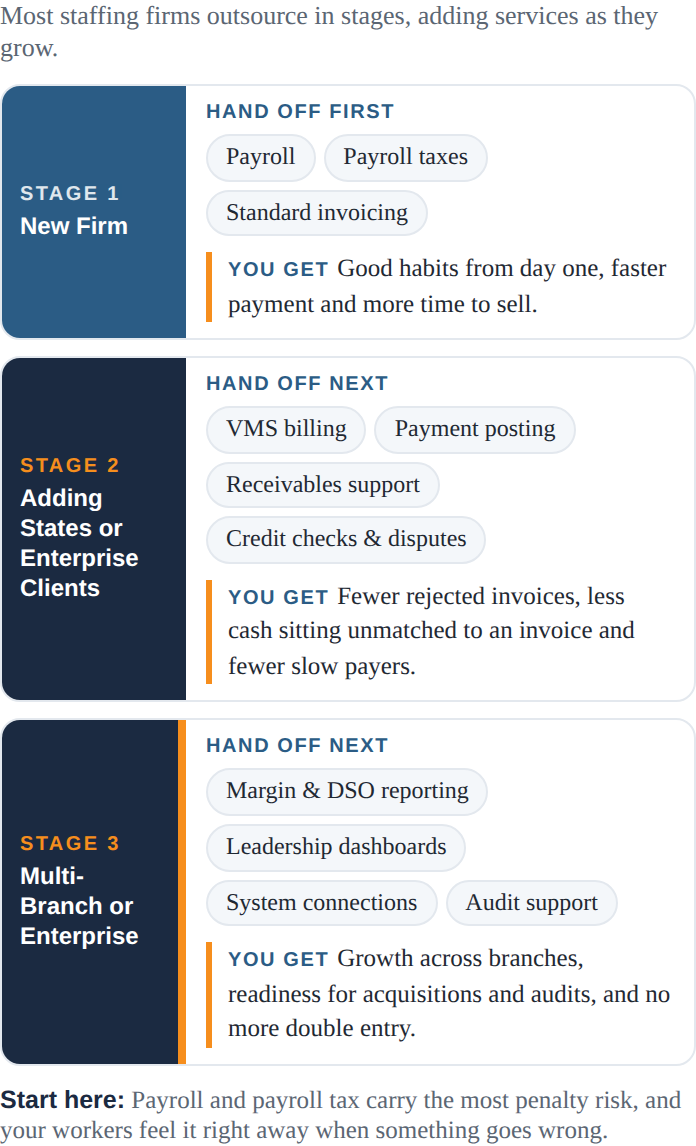
Payroll and payroll tax are almost always the right place to start. They carry the most penalty risk, and your workers feel it right away when something goes wrong.
Before and After: What Changes When You Hand It Off
Tax exposure: Before: your firm carries all the risk of multi-state filing errors and penalties. After: your partner handles the filings and compliance.
Visibility: Before: piecing together where every invoice stands from spreadsheets and bank statements. After: online cash and aging reports show you at a glance.
Cost as you grow: Before: more volume means more hires. After: costs rise and fall with your billings.
Continuity: Before: one key person quitting on a Wednesday can derail Friday. After: a whole team covers so payroll still goes out.
Cash timing: Before: you float payroll until clients pay. After: funding closes the gap between payday and payment.
Your Partner Checklist
- Do you only work with staffing firms? Ask for references in your verticals (light industrial, healthcare, IT, clerical) and proof of VMS experience.
- Can I buy just what I need? Look for modular options, such as funding only or full service, that can grow with you.
- Will you work with my systems? Make sure data can move cleanly from your ATS and timekeeping tools, and that you can export reports.
- How do you handle compliance? Multi-state payroll tax, wage and hour rules, and audit readiness should be standard.
- What does the transition look like? A phased rollout and a named contact are good signs. A generic support ticket queue is not.
- What exactly will I pay? Fees should be transparent, with no surprise charges for routine work.
How Madison Resources Helps
Madison Resources has backed staffing firms nationwide since 1992. With our funding-only program, you can receive a 90% advance on submitted invoices, funded weekly by ACH, with no application, setup or administration fees. When you’re ready to hand off more, our full-service program adds payroll processing, multi-state payroll taxes and invoicing, and full-service clients receive 100% funding. Your invoices, payment portal and checks all stay in your company’s name.
We make staffing companies more profitable. Call 800-508-3863 or email info@madisonresources.com.
Ready to start your funding journey? Partner with Madison Resources today [apply here]
Explore our website to find more staffing insights. Madison Resources is the premier payroll funding and back office support partner to the staffing industry. Grow with confidence.
Frequently Asked Questions About Staffing Back Office
Below are answers to some of the most common questions about Staffing Back Office.
What Is a Staffing Back Office?
A staffing back office handles everything between an approved timesheet and cash in your account. That covers payroll, payroll tax filings, invoicing (including VMS billing), posting payments, managing receivables, checking client credit and reporting on margin and DSO.
When Should a Staffing Firm Outsource Its Staffing Back Office?
When doing it yourself costs more than it’s worth. Common signs are payroll taking over your week, invoices taking longer to get paid, expanding into new states, or winning a client that bills through a VMS.
What Part of the Staffing Back Office Should I Outsource First?
Payroll and payroll tax. They carry the most penalty risk, and your workers feel it right away when something goes wrong. Most firms add invoicing and receivables support later.
Can I Outsource Just Part of My Staffing Back Office?
Yes. Many firms start with funding only and add payroll, multi-state payroll taxes or invoicing as they grow.
Will My Clients Know I Outsourced My Staffing Back Office?
Not with Madison Resources. Your invoices, client payment portal and checks all stay in your company’s name, so your clients keep dealing with you.
Will I Lose Control If I Outsource?
You should gain visibility. Madison Resources clients get online cash and aging reports, so they can see where every invoice stands at any time.
How Does My Staffing Back Office Affect What My Company Is Worth?
Buyers and lenders look closely at how fast your revenue turns into cash. High DSO, a messy aging report and frequent disputes signal risk and can lower your valuation. Clean, consistent processes help raise it.
How Do I Choose a Staffing Back Office Partner?
Look for a partner that works only with staffing firms, works with your systems, handles multi-state compliance, gives you a named contact and has transparent pricing.