

Search the cost to start a staffing agency and you’ll find lists that add up entity formation, a website, an ATS subscription, and a laptop, then conclude you need $15,000 and some hustle.
Those lists aren’t wrong about the line items. They’re wrong about the shape of the problem. They describe what it costs to have a staffing agency and skip what it costs to run one, and the difference between those two numbers is where most first-year firms fail.
Here’s what actually happens. You incorporate, get insured, buy software, and land your first client. Ten people start on a Monday. Two weeks later you write your first payroll for about $18,000. Your first invoice goes out at the end of that period, on Net 45 terms, and the money lands sometime around day 60. Meanwhile payroll runs again. And again. And again.
You didn’t need $15,000. You needed $15,000 plus the ability to fund eight consecutive payrolls with nothing coming in.
So let’s do this properly. Here is what it actually takes to start a staffing agency: what it costs to open, what it costs to operate, and what moves the number.
Two Buckets, and Only One of Them Is Usually Budgeted
Every honest answer to the cost to start a staffing agency has two parts.
Setup capital is one-time and predictable. Entity, insurance, software, screening, brand. You can quote all of it in a week.
Working capital is ongoing and scales with success. It’s the money that covers wages and burden between the hours worked and the invoice paid. It’s larger than setup capital by a factor of three to ten, and it grows every time you win.
That second bucket is the whole game. A staffing firm doesn’t fail because it couldn’t afford a website. It fails because it grew faster than its bank account.
Bucket One: What It Costs to Open the Doors
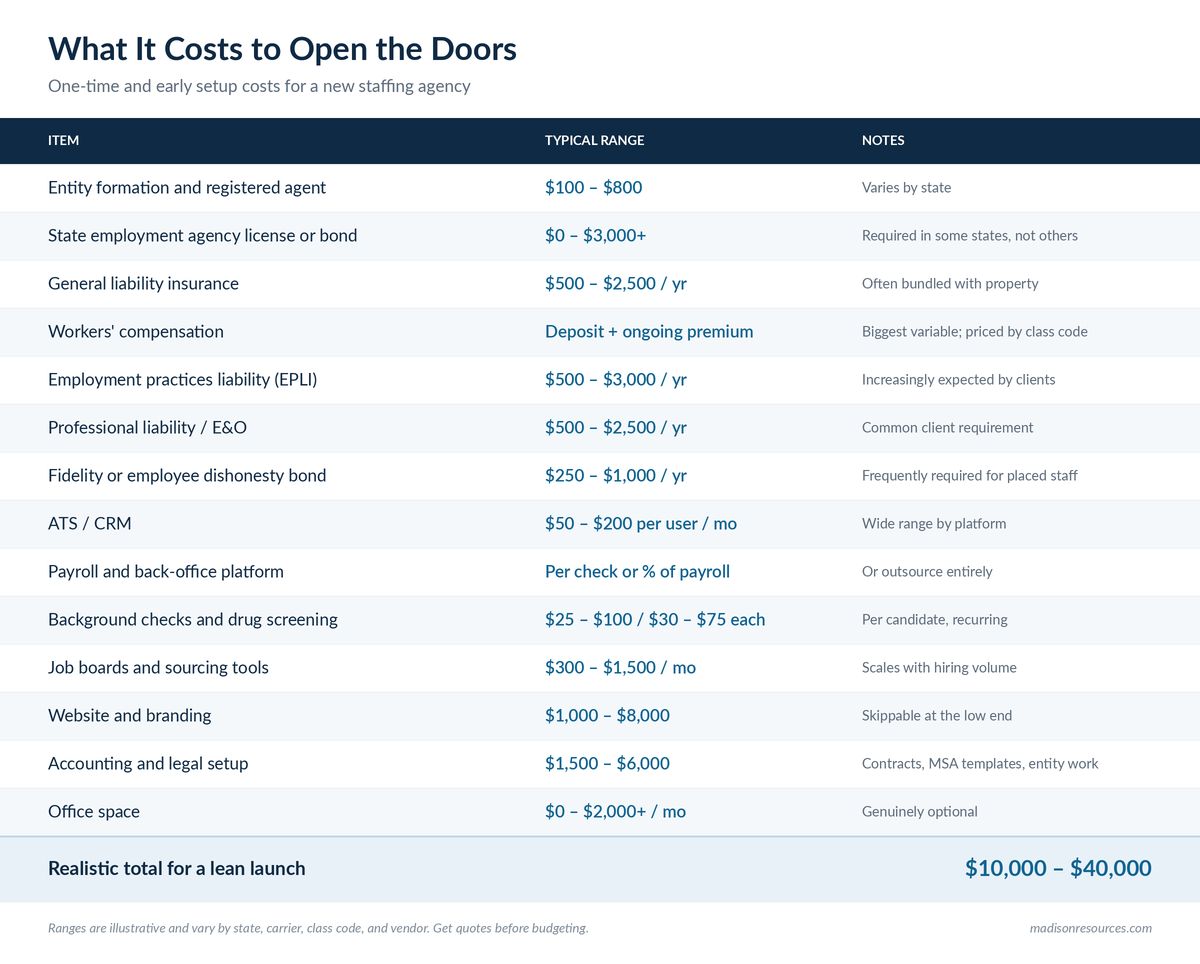
Realistic total for a lean launch: $10,000 to $40,000, depending mostly on your insurance profile and whether you’re remote.
Two line items deserve a closer look, because they’re where people underestimate badly.
Workers’ compensation is the single most variable cost in staffing and it’s priced per $100 of payroll by class code. Clerical work might run well under a dollar per $100. Light industrial commonly lands in the several-dollars range. Roofing, tree service, and similar high-hazard codes can exceed twenty. Carriers typically also want a deposit, often a meaningful percentage of estimated annual premium, and new agencies with no loss history get quoted conservatively. This one cost can swing your first-year budget by tens of thousands of dollars, and in some verticals the harder problem isn’t the price but finding a carrier willing to write you at all.
Client insurance requirements are the ones nobody warns you about. Your prospective client’s procurement team will send a certificate of insurance requirement specifying coverage types and limits, and it will frequently exceed what you thought you needed. Ask for that COI requirement during the sales conversation, not after you’ve won the account, because raising limits takes time and money.
Bucket Two: The Number That Actually Matters
Now the part the setup lists skip.
Take a straightforward light industrial desk: 10 field employees at $20 an hour, 40 hours a week.
Weekly gross wages are $8,000. But wages aren’t your cash outlay. Add employer FICA at 7.65%, state unemployment at a new-employer rate, federal unemployment, and workers’ comp premium at a light industrial rate, and your true weekly cash requirement is roughly $9,200.
Now the timeline. Your client is on Net 45, and real-world collection runs longer than the contract because of timesheet approval and invoicing lag. Call it 55 days from work performed to cash received, which is realistic and not pessimistic.
That’s about eight weeks of payroll you fund before the first dollar arrives:
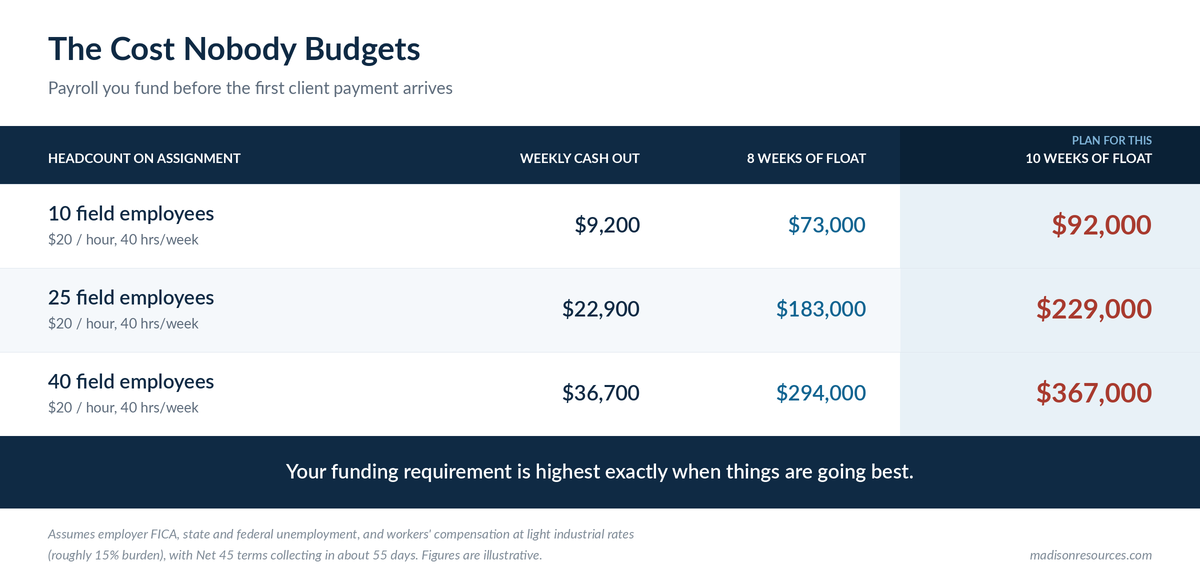
Look at what that table is telling you. Winning a bigger contract doesn’t relieve the pressure. It multiplies it. A 40-person order is a fantastic problem and a $294,000 cash requirement, and it arrives before any of the revenue does.
This is the structural fact that separates staffing from most other service businesses. Growth consumes cash. Your funding requirement is highest exactly when things are going best.
Why Your First Payment Is Further Out Than You Think
Founders model the terms and forget the pipeline in front of them. Count the actual days from a field employee’s first shift to money in your account:
- The work week itself: 7 days
- Timesheet submission and client approval: 2 to 5 days, longer if an approver is out
- Invoice preparation and submission: 1 to 3 days
- Contractual terms: 30, 45, or 60 days
- The client’s payment run and clearing: 3 to 7 days
On Net 45, that’s commonly 60 to 70 days from first shift to first dollar. On Net 60 it’s closer to 80. If your first client is an enterprise account running through an MSP or VMS, add more, because a single rejected line item pushes the whole invoice to the next cycle.
Budget from that number, not from the term on the contract.
Six Variables That Move Your Number
Pay rate and hours. Float scales directly with wages. Twenty IT contractors at $55 an hour is a dramatically larger cash requirement than twenty warehouse associates at $18, for the same headcount.
How fast you ramp. Adding people quickly is the fastest way to run out of money while profitable. Every start adds cash outflow now and revenue later.
Your workers’ comp class code. This drives both your premium and, in higher-hazard verticals, whether you can get covered at all.
Client payment terms. The difference between Net 30 and Net 60 on a 25-person desk is roughly $90,000 of additional working capital for identical work. Terms are a cost, and they belong in your pricing.
Temp versus direct-hire mix. Direct-hire placements require almost no float, since you’re not carrying payroll. They’re also non-recurring and lumpy, so cash arrives in unpredictable spikes. Temp is the opposite: predictable revenue, heavy float.
Where you operate. State unemployment rates, licensing and bonding requirements, and workers’ comp regulation all vary. Multi-state operations multiply the compliance work.
What It Costs by Vertical
Clerical and administrative is the cheapest entry point. Low workers’ comp rates, modest pay rates, minimal credentialing. The tradeoff is thin margins and heavy competition.
Light Industrial is the most common starting point. Manageable comp rates, straightforward onboarding, and volume that builds quickly. Your main exposure is turnover and the float that comes with scaling headcount fast.
Healthcare and nurse staffing carries the highest setup burden: credential verification, licensure tracking, immunization records, background and sanction checks, sometimes Joint Commission certification for larger contracts. Pay rates are high, which means float is high. Travel nurse arrangements add housing and stipend complexity. It’s the most capital-intensive common vertical and often the most profitable.
IT and professional has low workers’ comp costs and high pay rates, which flips the math: your setup is cheap and your float is enormous. A twelve-person contractor desk at $60 an hour is over $30,000 a week in cash out.
Construction and skilled trades brings the highest comp rates, certified payroll and prevailing wage requirements on public work, and stricter safety documentation. Carrier appetite is the binding constraint here more often than price.
Three Ways Founders Fund the Gap
Self-funding. Savings, a home equity line, retirement funds. No dilution, no interest, and complete personal exposure to a business whose cash needs grow with its success. The common failure isn’t that self-funding is wrong; it’s that founders self-fund the setup and assume revenue covers the rest.
Bank debt or an SBA loan. Cheaper capital if you qualify, but a new staffing agency has no operating history, few hard assets, and receivables a bank will discount heavily. A line of credit is also a fixed limit set on your past, which means a large new order can exhaust it exactly when you need it most.
Payroll funding. Also called invoice factoring when structured for staffing, it advances cash against your invoices so payroll clears on your schedule while clients pay on theirs. The relevant advantage for a startup is that availability moves with your receivables instead of sitting at a fixed ceiling, so winning a 40-person contract expands your capacity rather than breaking it. It’s not free, and the fee belongs in your bill rate. Compare it against the real alternative, which for most new firms is turning down the order.
Whatever you choose, decide before you need it. Arranging capital during a payroll shortfall is the most expensive time to do it.
When Do You Actually Pay Yourself?
Here’s a calculation nobody puts in a startup cost article.
Return to those 10 field employees at $20 an hour. Bill them at $31 and you’re producing about $12,400 in weekly revenue against roughly $9,200 in direct cost. Gross profit is around $3,200 a week, or about $14,000 a month.
Out of that comes your software, insurance, job boards, phone, accounting, and any recruiter you hire. What’s left is your income, and it isn’t much.
Run the same math at 25 field employees and gross profit is roughly $35,000 a month. That’s a business.
The practical implication: a ten-person desk is a proof of concept, not a living. Plan your personal runway on the assumption that you will not draw a real salary until you’re carrying 20 to 30 people on assignment, which typically takes six to twelve months. Add that number to your startup budget, because it’s as real as your insurance premium.
What Kills First-Year Agencies
Budgeting setup and ignoring float. The single most common error, and the reason for this entire article.
Winning too big, too early. A 50-person order from a recognizable company feels like validation. Without funding in place, it’s a liquidity event you can’t survive.
One client. Concentration is dangerous in any business and existential when you’re funding payroll from that client’s payment behavior.
Mispricing workers’ comp. Guessing at your comp rate instead of quoting it, then discovering your actual class code costs three times your assumption, converts every hour you bill into a loss.
Assuming your contractual terms are your real terms. They aren’t. Model DSO, not Net terms.
Forgetting the founder’s own income. Businesses fail because owners run out of personal money before the company runs out of company money.
The Takeaway
The cost to start a staffing agency splits into a number you can quote and a number you have to model. Setup runs $10,000 to $40,000 and is the easy part. Working capital is the real answer, and for even a small temp desk it means fronting eight to ten weeks of payroll plus burden before your first client payment arrives, with that requirement growing every time you win new business.
So build your budget in this order. Get real quotes for insurance and workers’ comp in your actual class codes. Calculate weekly cash out for your first realistic headcount, including burden. Multiply by ten weeks, not the contract term. Add your personal runway until the desk supports a salary. Then arrange your funding before you need it.
Do that and the business is straightforward. Skip the float calculation and no amount of sales talent will save you.
Where Madison Resources Fits
Madison Resources funds staffing firms, including new ones. Payroll funding advances cash against your invoices so payroll clears on time while clients pay on their own schedule, and because availability scales with your receivables rather than a fixed credit limit, a large new contract expands what you can take on instead of stopping you.
We also handle the back-office work that new firms usually underestimate: invoicing, cash application, A/R and collections support, and reporting. That matters more in year one than founders expect, since the fastest way to lengthen your own DSO is to invoice late or incorrectly.
If you’re building a model for launching a firm and want help pressure-testing the working capital assumptions, or you’re already running and the float has become the constraint, get in touch with our team.
Ready to start your funding journey? Partner with Madison Resources today [apply here]
Explore our website to find more staffing insights. Madison Resources is the premier payroll funding and back office support partner to the staffing industry. Grow with confidence.
Frequently Asked Questions About the Cost to Start a Staffing Agency
Below are answers to some of the most common questions about the Cost to Start a Staffing Agency.
What Is the Real Cost to Start a Staffing Agency?
The cost to start a staffing agency isn’t just the $10,000 to $40,000 in setup expenses, entity formation, insurance, software, and screening. The bigger and often-ignored part of the cost to start a staffing agency is working capital: the cash needed to fund payroll for weeks before clients pay their invoices.
Why Do Most Estimates Get the Cost to Start a Staffing Agency Wrong?
Most estimates only capture what it costs to have a staffing agency, not what it costs to run one. The real cost to start a staffing agency includes funding eight to ten weeks of payroll before the first invoice is ever paid.
How Much Does Working Capital Factor Into the Cost to Start a Staffing Agency?
Working capital is usually three to ten times larger than setup capital, and it’s the part of the cost to start a staffing agency that actually determines whether a firm survives its first year. It grows every time you win a new account.
Does Workers' Compensation Affect the Cost to Start a Staffing Agency?
Significantly. Workers’ comp is one of the most variable pieces of the cost to start a staffing agency, since rates are priced per $100 of payroll by class code and can range from under a dollar to over twenty dollars depending on the vertical.
How Do Client Payment Terms Change the Cost to Start a Staffing Agency?
Payment terms directly affect the working-capital side of the cost to start a staffing agency. The longer it takes a client to pay, Net 45, Net 60, or longer with MSP/VMS delays, the more payroll cycles a firm has to fund before it collects.
What's the Best Way to Cover the Cost to Start a Staffing Agency?
Founders typically self-fund, use bank debt or an SBA loan, or use payroll funding, also called invoice factoring. Payroll funding tends to fit the true cost to start a staffing agency best, since availability grows with receivables instead of sitting at a fixed limit.
Related Articles

Net 30 vs. Net 60 vs. Net 90: The Hidden Price Tag on Your Client Contracts
Net 30, Net 60, Net 90 payment terms decide how many weeks of payroll your staffing firm has to finance before a client’s money arrives. Here’s what each term actually costs in cash, why your real DSO runs longer than your contract says, and how to protect growth without stalling it.

Credit Analysis in Staffing Factoring: Protect Cash Flow
Learn how credit analysis in staffing factoring helps evaluate customer risk, protect receivables, identify red flags, prevent fraud, and support healthy cash flow for staffing firms.

LLC vs S Corporation for Staffing Firms: Which Is Better?
Choosing the right business structure is one of the first major decisions when starting a staffing firm. The choice between an LLC and an S Corporation can impact how you’re taxed, how you pay yourself, and how your company grows. By understanding the key differences between these two options, staffing entrepreneurs can select the structure that best supports their long-term financial and operational goals.

Staffing Company Startup Guide for Entrepreneurs
Recruiting experience alone won’t build a staffing company that lasts. This staffing company startup guide walks through the niche selection, compliance, cash flow, and back-office decisions that actually separate firms that scale from firms that stall out in year one.