Landing a big new contract feels like the finish line. But for staffing agency cash flow, it’s usually the starting gun.
The day your new placements start, you owe them wages. Every week, like clockwork. The client that signed the deal may not pay its first invoice for 45, 60 or 90 days. Multiply that gap across a growing roster and a firm that looks healthy on paper can struggle to fund Friday’s payroll.
Here are seven funding mistakes we see again and again as staffing firms grow, and what to do about each one.
1. Assuming More Revenue Means More Cash
In most businesses, selling more puts more money in the bank. Staffing works in reverse. Every new placement adds to your weekly payroll right away, while the matching revenue sits in receivables for weeks.
Here’s a simple example. Say you add 25 light industrial workers at $20/hour, 40 hours a week. That’s $20,000 in new gross wages every week, before taxes and workers’ comp. On Net 60 terms, you’ll run about eight or nine payrolls before the first dollar from that client arrives. That’s more than $170,000 you have to float, just to support one win.
The fix: Look at cash and profit separately. A weekly cash projection that runs at least a quarter ahead shows you when a new contract will squeeze payroll, while you still have time to plan for it.
2. Expecting a Bank Line to Grow as Fast as You Do
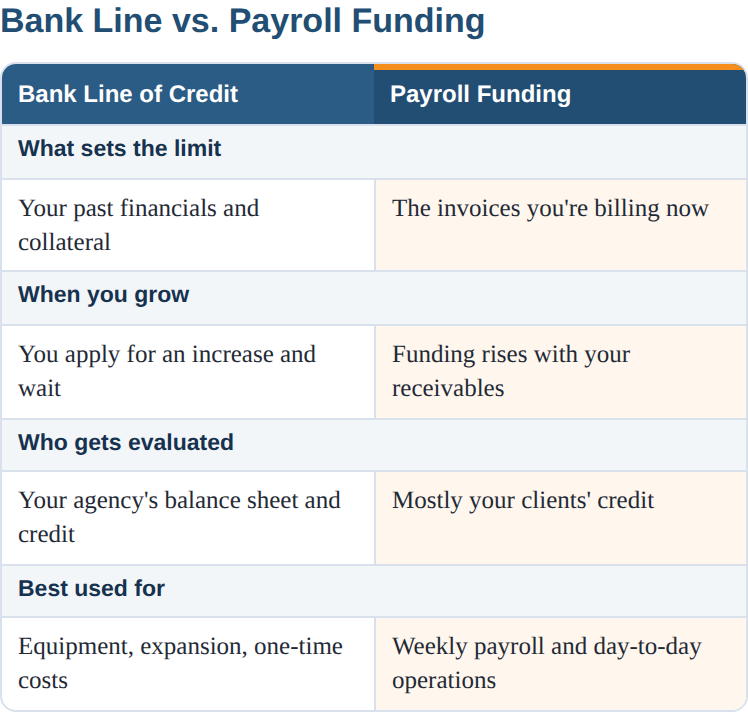
Bank lines have their place. But the limit is usually set on your past financials, not your current billing. Raising it can take weeks of underwriting, and covenants can tighten right when you’re growing fastest and need them to loosen.
The fix: Line up a second source of working capital before you need it. Don’t wait for a maxed-out line or an annual review to force the conversation.
How the Two Options Compare
3. Leaving the Cost of Money Out of Your Bill Rate
This one sneaks up on firms chasing MSP, VMS and government contracts. The terms are long, the fees are fixed, and there’s little room to renegotiate once you’ve signed. If your markup doesn’t account for waiting 60+ days to get paid, strong hours can still produce thin margins.
The fix: Build every rate from the ground up:
- Pay rate
- Payroll taxes and statutory costs (FICA, FUTA, SUTA, workers’ comp)
- Program or VMS fees
- Screening, credentialing and onboarding costs
- Overhead per hour
- Funding cost (for example, 2.5% of billings on a $36 bill rate adds about $0.90 per hour)
- Your target profit
If that funding line isn’t in your rate model, you’re paying for it out of your margin.
4. Letting One or Two Clients Run Your Receivables
Growth often comes from a few large accounts. That’s great until one of them changes its AP process, disputes an invoice or slows its payments by a couple of weeks. When one client makes up 40% of your receivables, its problem becomes yours.
The fix: Check a client’s credit before you staff up, not after. Set internal limits on how much any single client can make up of your receivables, and assign one person on your team to track each major account’s payment status.
5. Letting Paperwork Slow Down Your Invoices
Your days sales outstanding (DSO) usually starts to climb before a client pays late. It starts when the invoice goes out late or incomplete. A missing timesheet approval, the wrong PO number or an expired credential in a VMS portal can quietly turn Net 60 into Net 90.
The fix: Tighten the steps between the hours worked and the invoice sent. Set firm weekly time cutoffs. Confirm the approver and a backup approver for every client at onboarding. Follow up on missing time within a day or two instead of at month end.
6. Looking for Funding After You've Won the Contract
The worst time to set up working capital is the week a new contract doubles your payroll. Underwriting takes time, and you’ll be negotiating under pressure.
The fix: Set up your funding while things are calm. With payroll funding, your available cash grows as you bill more.
7. Ignoring the Warning Signs
Firms rarely outgrow their funding all at once. It shows up in small decisions first:
- You’re turning down business you could staff. You have the recruiters and the candidates, but you pass on an RFP because you’re not sure you can carry the payroll.
- Your credit line never comes down. It stays at or near the limit, and business credit cards are covering the rest.
- You’re paying yourself last. You’re paying vendors late, holding back internal bonuses or putting in personal money to cover payroll.
- Cash decides your client list. You’re choosing clients based on how fast they pay, not how good they are for the business.
If two or more of these sound familiar, your funding setup is holding back your growth.
The Takeaway
Growth doesn’t break staffing firms. Growth their funding can’t keep up with does. The agencies that scale smoothly plan cash as carefully as they plan sales. They price in what it costs to wait for payment, they don’t rely too heavily on one client, they keep invoices moving, and they have working capital ready before the big contract arrives.
Madison Resources has helped staffing firms nationwide fund their growth since 1992, with optional payroll processing, multi-state payroll taxes and invoicing support. If your next big win would put pressure on your payroll, let’s talk before it lands.
Call 800-508-3863 or contact us here.
Ready to start your funding journey? Partner with Madison Resources today [apply here]