
Nonfarm payrolls went backward in the July 2026 jobs report, falling by 23,000, and the two months before that were revised down by a combined 103,000. Temporary help employment rose for the seventh consecutive month. Those two facts sitting next to each other are the most important thing in this report, and they are worth more of your attention than the headline.
The short version: payroll growth has stalled, the unemployment rate is flattered by people leaving the labor force rather than finding work, and employers who need labor are increasingly getting it on a temporary basis instead of adding permanent headcount.
The Headline Number Went Backward
A decline of 23,000 jobs is a small number in an economy this size. The revisions matter more. When May and June are marked down by 103,000 between them, it tells you the picture you were working from two months ago was wrong, and it was wrong in the direction of weakness.
Some of the July softness has an explanation that will not repeat. Seasonal education adjustments moved the number. Government continued to sit out. Hospitality gave back jobs as the World Cup tournament ended, which was always going to happen on that calendar.
Strip those out and you are left with an economy that is not shedding workers in any alarming way but is not creating many either.
Worth noting the divergence between the two payroll surveys. ADP reported 44,000 jobs added in July while BLS reported a loss of 23,000. Those are not in conflict. ADP measures private employers only, and BLS includes government. A private sector adding modestly while the public sector subtracts is precisely the pattern that produces those two numbers, and it reinforces the point about government hiring rather than undercutting it.
The Unemployment Rate Is Not the Good News It Looks Like
The rate held at 4.1%. On its own that reads as a healthy labor market, and in one narrow sense it is, because employers are plainly not conducting broad layoffs.
But look at how the rate got there. Labor force participation fell another tenth of a point to 61.4%, which is 1.8% below where it stood in February 2020. The unemployment rate is a fraction, and when people stop looking for work they leave the denominator entirely. A rate that falls because the labor force is shrinking is not the same thing as a rate that falls because people found jobs.
One genuine bright spot underneath it. Prime age participation, ages 25 to 54, actually rose a tenth to 83.4%. The people most likely to be working are still working. The decline is happening at the edges.
The broader U6 measure, which counts discouraged workers and people holding part-time jobs because they cannot find full-time work, held at 7.9%. That number not improving is consistent with everything else here.
Seven Straight Months of Temporary Help Growth
Here is where staffing owners should slow down.
Temporary help employment is traditionally read as a leading indicator. When a slowdown is coming, temp goes first, because contract workers are the easiest labor to release and employers cut them before they cut permanent staff. When a recovery is coming, temp turns up first for the same reason in reverse.
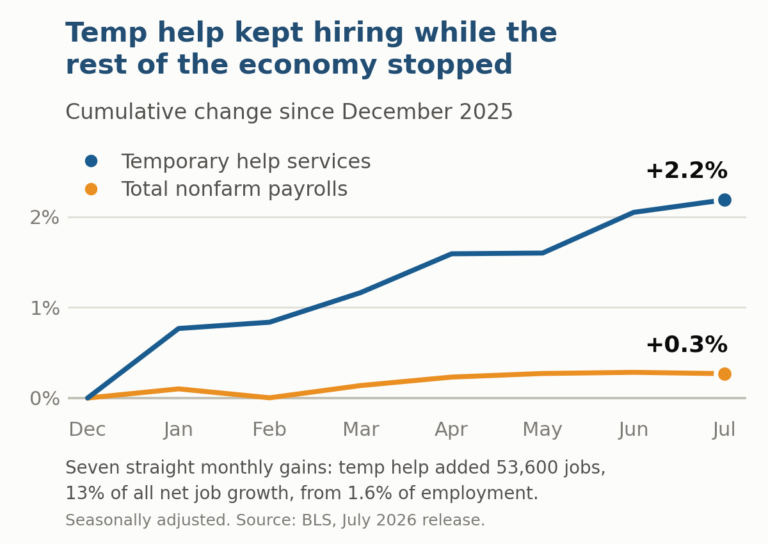
That is not what is happening. Temp help has risen seven months in a row while total payrolls went flat and then negative. Over those seven months temp added 53,600 jobs, which is 13% of all the net job growth in the economy, out of a sector that is 1.6% of employment. Temp is not leading a broader hiring wave. It is absorbing demand that would previously have gone to permanent headcount.
Pair that with the JOLTS data, which lags a month. June openings held flat at 7.4 million. The quits rate sat at 2% and the layoff rate at 1.1%. Nobody is leaving and nobody is being pushed out. Nick’s phrase for it is low hire, low fire, rinse, repeat, and it is the right description.
That combination tells you something specific about employer psychology. These companies have work. They are posting openings. What they will not do is commit to a permanent hire in an environment they cannot forecast, because a permanent hire is a decision that is expensive to reverse and a contract worker is not. Seven months of that calculation, made one company at a time, is what the two lines are showing you.
What This Means for Your Fill Rates
If your clients are behaving like the aggregate data, the conversation you are having with them has changed.
The pitch is no longer that you can find talent faster than they can. It is that you can give them capacity they are not obligated to keep. In a frozen market the flexibility is the product, and it is worth more right now than the speed is.
Two practical consequences.
First, expect longer assignments and higher conversion resistance. Clients using temp as a substitute for permanent hiring will extend rather than convert, because converting is the exact commitment they are avoiding. Build your rate structure and your contracts with that in mind rather than assuming a placement fee at the end.
Second, wage data says you have less room than you might think. Average hourly earnings came in at $37.62, up two cents, and up 3.2% over the year. Production and nonsupervisory earnings were $32.40, up four cents. Pay is drifting, not surging. If your bill rates are rising faster than that, you are asking clients to absorb margin expansion in a month when they just read the same jobs report you did.
The workweek tells a similar story. Overall hours held at 34.3. Manufacturing held at 40.4 with overtime down a tenth to 3.1 hours. Employers are not stretching their existing people to the limit, which means the pressure that usually forces a hiring decision is not building yet.
The Part That Costs Money
There is a version of this environment that is very good for staffing firms and a version that quietly hurts them, and the difference is working capital.
If temp demand is growing while permanent placement slows, your revenue mix shifts toward the business that consumes the most cash. Every additional temporary worker is a payroll you fund weekly against an invoice you collect on net 30 or net 45. Growing temp headcount in a market like this means your cash requirement climbs faster than your profit does.
That is the trap. The report says opportunity, your P&L agrees, and your bank balance disagrees. This is the constraint Madison Resources exists to solve, and it is why we work only with staffing companies. When the market hands you volume you can fill, the last thing that should stop you is the gap between Friday and net 45.
Where This Leaves Us
The labor market is not falling apart. It is not going anywhere either.
Low hire, low fire, rinse, repeat. For most industries that is a frustrating place to be. For staffing firms it is the environment we were built for, because uncertainty is exactly when a client would rather rent capacity than own it.
Seven months in a row is not noise. Plan like it continues.
Ready to start your funding journey? Partner with Madison Resources today [apply here]
Explore our website to find more staffing insights. Madison Resources is the premier payroll funding and back office support partner to the staffing industry. Grow with confidence.
Frequently Asked Questions About the July 2026 Jobs Report
Below are answers to some of the most common questions about the July 2026 Jobs Report.
What Did the July 2026 Jobs Report Show?
The July 2026 jobs report showed nonfarm payrolls fell by 23,000, with May and June revised down by a combined 103,000. The unemployment rate held at 4.1%. Temporary help employment rose for the seventh consecutive month. The headline decline was partly seasonal education adjustments, continued government contraction, and hospitality giving back World Cup hiring.
Why Did the Unemployment Rate Stay at 4.1% if Payrolls Fell?
Because the labor force shrank. Participation fell another tenth to 61.4%, which is 1.8 points below February 2020. The unemployment rate is a fraction, and people who stop looking for work leave the denominator entirely. A rate that holds because the labor force is contracting is not the same as one that holds because people found jobs.
What Is Temporary Help Employment, and Why Do Economists Watch It?
Temporary help employment counts workers placed by staffing firms on contract assignments. It is traditionally read as a leading indicator. Contract labor is the easiest to release, so employers cut temp before permanent staff when a slowdown is coming, and add temp first when a recovery starts. It usually turns before the broader market does.
Why Is Temporary Help Rising if the Labor Market Is Slowing?
Because temp is not leading a recovery this time. It is substituting for permanent hiring. Temp help added 53,600 jobs over seven months, 13% of all net job growth from a sector that is 1.6% of employment, while total payrolls went flat. Employers have work but will not commit to headcount they cannot forecast.
What Does "Low Hire, Low Fire" Mean?
It describes a labor market where almost nothing moves in either direction. The June JOLTS data showed openings flat at 7.4 million, a quits rate of 2%, and a layoff rate of 1.1%. Employers are not laying off, and workers are not leaving voluntarily. Demand exists, but nobody is making a commitment.
Why Did ADP and BLS Disagree in the July 2026 Jobs Report?
They measure different things. ADP reported 44,000 private jobs added while BLS reported a net loss of 23,000. ADP covers private employers only; BLS includes government. A private sector growing modestly while the public sector contracts produces exactly that split. The two figures are consistent, not contradictory.
What Do the Downward Revisions in the July 2026 Jobs Report Mean?
Revisions of that size mean the earlier picture was wrong, and wrong toward weakness. May and June were marked down by 103,000 combined. BLS revises as more employer responses arrive, so early estimates for any month are provisional. Persistent downward revisions are a signal in themselves that hiring is decelerating faster than first reported.
What Does the July 2026 Jobs Report Mean for Staffing Companies?
It means flexibility, not speed, is the product right now. Clients using temp as a substitute for permanent hiring will extend assignments rather than convert, so expect conversion resistance and build contracts accordingly. Wage growth of 3.2% also caps how far bill rates can move. The constraint is cash: every temp placement is a payroll funded weekly against a net 30 or net 45 invoice.
What Did the July 2026 Jobs Report Say About Wages?
Average hourly earnings came in at $37.62, up two cents for the month and 3.2% over the year. Production and nonsupervisory earnings were $32.40, up four cents. Pay is drifting rather than surging. For staffing firms, that 3.2% figure is a practical ceiling on how fast bill rates can move without client resistance.
What Does the July 2026 Jobs Report Show About the Average Workweek?
The average workweek held at 34.3 hours. Manufacturing held at 40.4 hours with overtime down a tenth to 3.1 hours. This matters because employers typically stretch existing staff before hiring. Flat hours and falling overtime mean the pressure that normally forces a hiring decision is not building yet.
What Is the u6 Rate in the July 2026 Jobs Report?
U6 held at 7.9%. It is the broadest underemployment measure, counting discouraged workers who have given up searching and people working part-time because they cannot find full-time work, alongside the officially unemployed. U6 failing to improve while the headline rate holds steady confirms the labor market is stalled rather than healing.
What Industries Lost Jobs in the July 2026 Jobs Report?
Government continued to contract. Leisure and hospitality gave back jobs as World Cup tournament hiring unwound, which was always going to happen on that calendar. Seasonal education adjustments also moved the number. Strip those out and the picture is an economy neither shedding workers meaningfully nor creating many.
What Does the July 2026 Jobs Report Say About Labor Force Participation?
Overall participation fell another tenth to 61.4%, which is 1.8 points below February 2020. That decline is the main reason the unemployment rate held at 4.1%. One bright spot underneath it: prime-age participation for ages 25 to 54 rose a tenth to 83.4%. The people most likely to be working still are.
Does the July 2026 Jobs Report Mean Employers Have Stopped Hiring?
No. Job openings held at 7.4 million and the layoff rate sat at 1.1%, so employers still have work and are not cutting. What they have stopped doing is committing to permanent headcount. Demand is being met with contract labor instead, which is why temporary help has grown for seven straight months.
How Does the July 2026 Jobs Report Compar toe June?
June was revised down to 20,000 jobs added, from an initial 57,000. July came in at negative 23,000. May was also cut, from 129,000 to 63,000. The trend across all three months is deceleration, and each revision has moved in the same direction, which is itself the signal worth watching.