

Ask a staffing owner what their biggest constraint is and you’ll usually hear “good candidates” or “the right clients.” Ask them what keeps them up on a Thursday night and the answer changes. It’s whether Friday’s payroll clears. More often than not, the reason comes down to the Net 30, Net 60, Net 90 payment terms sitting in their client contracts.
That anxiety traces back to a handful of characters. Net 30 means a client has 30 days from the invoice date to pay. Net 60 means 60. Net 90 means 90. Nothing complicated about the definitions. What makes them expensive in this industry is that your employees don’t wait 60 days. They get paid every Friday, or every other Friday, and there is no version of the business where that slips.
So you cover the wages now and collect later. In the space between, you are functionally lending money to a company that is almost certainly larger and better capitalized than you are. Understanding what that loan costs and how to stop it from capping your growth is the difference between a staffing firm that scales and one that stays exactly the size its bank account allows.
You Already Run a Lending Business
Two pieces of vocabulary make the rest of this clearer.
Your net terms are contractual: the days a client gets after invoicing. Your DSO, or Days Sales Outstanding, is empirical: how long invoices actually take to become cash once you add approval cycles, corrections, portal quirks, and the occasional dispute.
Owners plan around net terms. They live with DSO. And DSO is nearly always the larger number.
Staffing operates on a negative cash cycle, meaning cash exits before it enters. Manufacturers hold inventory. Consultants bill against a retainer. You issue paychecks on Friday for revenue that may not arrive until October. Stretching terms doesn’t reduce your profit , it stretches the runway you have to cover on your own before that profit materializes.
Counting the Weeks You Have to Carry
The cleanest way to price a set of terms is to stop thinking in days and start thinking in payrolls.
Take a firm running 55 field employees at $21 an hour, 40 hours a week. Gross wages come to about $46,200 every week. Treat that as the floor, not the number, employer FICA, FUTA, SUTA, workers’ compensation premiums, and your own recruiting and admin overhead all sit on top of it.
Here is what that firm has to carry before collections catch up:
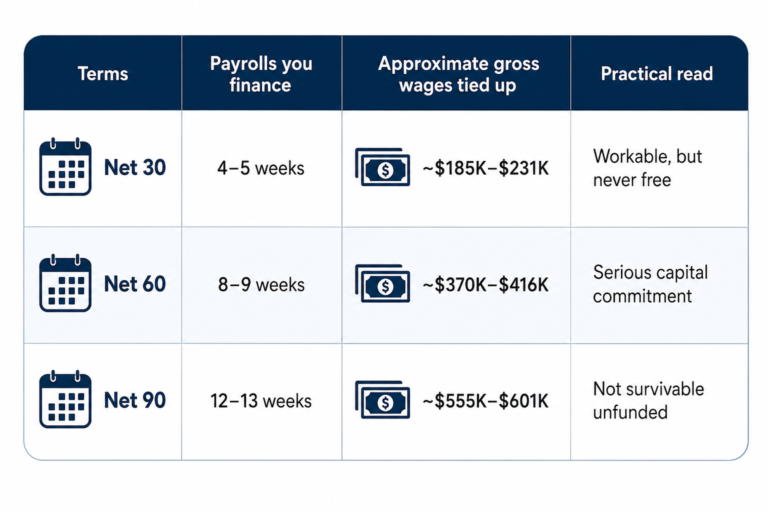
Same 55 people. Same margin per hour. Same client quality. The only variable is the calendar, and it swings the cash requirement by roughly $370,000.
This is why so many owners describe feeling profitable and broke simultaneously. Both are true. Margin is a percentage that shows up on a statement. Payroll is cash that leaves a bank account on a fixed date.
Your Real Terms Are Worse Than Your Written Terms
Here’s the part that surprises people who’ve only worked with mid-market clients: on Net 60 and Net 90 accounts, the contract is a best case.
Large corporate buyers and MSP and VMS programs in particular route invoices through several layers of review before accounts payable is even involved. That process is unforgiving of small errors. A timesheet that never got approved, a rate that doesn’t match the rate card, a purchase order number entered one digit off, an invoice submitted as a PDF when the program requires EDI. None of those get quietly corrected. The invoice gets kicked, and by the time you’ve fixed it, the payment window has closed and you’re waiting for the next cycle. Net 60 becomes Net 75 without anyone changing a contract.
Disputes and short pays do double damage. They delay the cash and, when credits get issued, they permanently reduce what you collect. Meanwhile the collections work itself scales with the length of the terms, longer cycles demand a tighter follow-up rhythm and better documentation just to keep aging from creeping.
Concentration is where all of this turns dangerous. If one buyer accounts for a large share of your receivables, their AP department’s habits become your cash flow. A single sluggish cycle on that account doesn’t inconvenience you; it determines whether you make payroll.
And there’s a quieter cost nobody invoices you for. To operate safely on extended terms, you have to keep a meaningfully larger pile of cash sitting still, purely as timing insurance. That money isn’t hiring a recruiter, upgrading your ATS, or funding a new market. It’s parked. Long terms don’t just delay revenue, they immobilize the capital that was supposed to grow the business.
Waiting Is a Cost, So Put It in the Rate
If a longer DSO raises your cost of capital, then it belongs in your bill rate the same way workers’ comp does. Build the rate from the ground up and confirm your margin dollars cover delivery and delay.
A complete build accounts for the pay rate, statutory burden (employer FICA, FUTA, SUTA, workers’ compensation), any program or MSP fees plus an honest allowance for disputes and credits, your overhead per hour across recruiting, technology, and administration, the cost of the capital your DSO ties up, and finally your target profit in dollars per hour.
Leave out the cost of capital and you’ll book work at a markup that reads well and earns less than you think. Two accounts with identical spreads are not equally profitable if one pays in 32 days and the other in 78.
How Terms Become a Ceiling
The constraint rarely announces itself as a cash problem. It shows up as a series of decisions that feel reasonable in isolation.
You slow a headcount ramp, because every start adds payroll immediately and revenue much later, growth burns cash before it produces any. You delay opening a branch or a new vertical, because expansion multiplies the timing gap rather than diversifying away from it. You discover your line of credit doesn’t move at the speed a new order does; bank limits are set on last year’s numbers. And eventually you turn down a large, long-term program with excellent economics because you can’t fund the first ninety days of it.
That last one is worth sitting with. The firms winning enterprise accounts on Net 60 aren’t better negotiators. They’re better capitalized, which lets them treat terms their competitors can’t absorb as a moat.
A Working Playbook, in Three Layers
Managing long terms isn’t one tactic. It’s three separate jobs: fix the deal, fix your own house, and fix the funding.
Layer one: get it right before go-live
Terms are never more negotiable than in the weeks before a contract is signed. Ask for an early-payment discount. Ask for weekly or milestone approvals so you can bill in pieces instead of waiting on a full cycle. And spend real time on the unglamorous mechanics, purchase orders, cost centers, rate cards, mandatory invoice fields, submission format, who approves and who backs them up. Every one of those settled in advance is an invoice that doesn’t get rejected later.
Layer two: shorten the distance between work and invoice
A surprising share of what gets blamed on slow-paying clients is really slow invoicing. Train field employees on time capture and submission cutoffs, and enforce them. Know your approver and their backup by name. Reconcile approved hours against the invoice before it goes out, in the exact format the client requires. Then review missing time and pending approvals every single week and escalate aging invoices against a documented timeline rather than a gut feeling.
Credit policy belongs in this layer too. Set limits per buyer. Track DSO by client and by program instead of trusting a company-wide average that conceals your worst accounts. Keep the account mix diversified enough that no single payer can dictate your week, and revisit terms with clients who dispute or delay as a matter of habit.
Finally, build a rolling 13-week cash forecast with base, upside, and downside cases and watch the indicators that move first: approvals-to-invoice cycle time, DSO by client, dispute rate, and weeks of payroll coverage against upcoming runs. Pair each with a trigger so the decision is already made. If DSO runs past 55 days two weeks running, tighten credit on new orders and escalate collections that day.
Layer three: fund the gap deliberately
Payroll funding (invoice factoring structured for staffing) advances cash against eligible invoices so payroll clears on your schedule while clients pay on theirs. Advances typically run up to 90% of invoice value, and up to 100% in some full-service arrangements; when the client pays, the remainder is released net of the fee.
The structural advantage isn’t just speed. It’s that availability moves with your receivables instead of sitting at a fixed limit, so a large new order expands your capacity rather than consuming it and it does that without adding conventional bank debt. Timelines vary by situation, though many firms are approved in roughly two to three weeks once documentation is in. Eligibility depends on factors like client credit quality and funding volume.
What a New Contract Actually Asks For
Return to that 55-person firm. It wins a new account requiring 30 additional workers at similar rates, about $25,200 more in weekly gross wages, starting the first week anyone works a shift.
On Net 30, the firm needs to carry roughly a month of that new payroll before collections begin. On Net 60 or Net 90, the same contract demands two to three months of coverage up front, and that’s before burden and overhead.
Notice what didn’t change: the margin, the client, the quality of the work. Only the payment window moved, and it multiplied the cash requirement. That’s how a deal worth winning becomes the reason a firm runs short.
Five Questions to Answer Before You Sign
- At your current DSO — not your contractual terms — how many weeks of payroll can you cover today?
- What does DSO actually look like on your comparable clients and programs?
- Does your bill rate on this account include the cost of capital for a 60- or 90-day wait?
- Can your back office meet this client’s billing and EDI requirements without adding delay of its own?
- Is your funding structured to expand as the receivable grows?
If any of those answers is a guess, the terms are the risk, not the client.
The Takeaway
Net 30, Net 60, and Net 90 are not administrative details. They set how fast you can grow, what you have to charge, and how much risk you carry into every Friday. Price for the wait, compress the distance between hours worked and invoice submitted so your written terms don’t quietly become worse ones, and put working capital in place that scales with your receivables rather than capping them. Get those three right and you can keep payroll reliable while still saying yes to the accounts worth having — in any market.
How Madison Resources Fits In
Madison Resources helps staffing firms close the gap between payroll and collections. We provide payroll funding tied directly to your invoices, along with back-office support built to bring DSO down: invoicing, cash application, A/R and collections assistance, and reporting.
Advance rates and timelines depend on the situation. We typically advance up to 90% of eligible invoice value and up to 100% in full-service arrangements, with funding available immediately once you’re set up.
If you’d like to model what a Net 60 or Net 90 program would do to your cash position, or talk through funding before you commit, get in touch with our team.
Ready to start your funding journey? Partner with Madison Resources today [apply here]
Explore our website to find more staffing insights. Madison Resources is the premier payroll funding and back office support partner to the staffing industry. Grow with confidence.
Frequently Asked Questions About Net 30, Net 60, Net 90 Payment Terms
Below are answers to some of the most common questions about Net 30, Net 60, Net 90 Payment Terms
What are Net 30, Net 60, Net 90 Payment Terms?
They’re the contractual window a client has to pay an invoice after you issue it. Net 30 means payment is due within 30 days of the invoice date, Net 60 within 60 days, and Net 90 within 90 days. The word “net” simply means the full balance with no deductions. The clock almost always starts at the invoice date rather than the date the work was performed, which is an important distinction in staffing: if you bill a week late, you’ve added a week to your own wait.
Why Do These Payment Terms Matter More to Staffing Firms Than to Other Businesses?
Because of the direction cash moves. Most businesses collect before or around the time they incur their costs, but under Net 30, Net 60, Net 90 payment terms a staffing firm does the opposite. A staffing agency pays field employees weekly or biweekly and then waits 30, 60, or 90 days to be reimbursed by the client. That’s called a negative cash cycle, and it means your growth is financed entirely out of your own balance sheet until collections catch up. The longer the terms, the more of your own money is committed to work you’ve already delivered.
How Many Weeks of Payroll Do I Have to Float Under Each Term?
As a working rule, Net 30, Net 60, Net 90 payment terms translate to roughly four to five weeks of payroll under Net 30, eight to nine weeks under Net 60, and twelve to thirteen weeks under Net 90. The float exceeds the stated term because you’re covering payroll continuously during the wait, not just once. Note that these figures cover gross wages only. Employer FICA, FUTA, SUTA, workers’ compensation, and overhead all raise the real cash requirement.
What's the Difference Between Net Terms and DSO?
Net terms are what the contract promises. DSO, or Days Sales Outstanding, is what actually happens. DSO measures the average number of days it takes an invoice to convert to cash, including approval delays, rejections, corrections, and disputes. Net terms are a planning assumption; DSO is a measured result. Any gap between them is unfunded risk, so measure DSO by client rather than assuming your Net 30, Net 60, Net 90 payment terms describe what will actually happen.
Why Is My DSO Longer Than My Contractual Terms?
Usually because of what happens before accounts payable ever sees the invoice. Timesheets have to be approved, hours have to match the rate card, purchase order numbers have to be correct, and the invoice has to arrive in the required format. Any break in that chain gets the invoice rejected rather than corrected, and once you’ve fixed it the payment cycle has often already closed. Add a few of those events together and Net 60 behaves like Net 75 or Net 80.
Which of These Terms Is Most Common in Staffing?
It varies by client size. Small and mid-market employers frequently accept Net 30. Large enterprises, and especially accounts running through an MSP or VMS, more often standardize on Net 45, Net 60, or Net 90 because their internal payment cycles and procurement policies are built that way. Bigger buyer, longer terms, is the general pattern, which is exactly why growing upmarket increases your working capital requirement.
Can I Negotiate Shorter Payment Terms?
Sometimes, and your leverage is highest before the contract is signed. Once you’re operating, terms are effectively locked. Instead of asking a large buyer to abandon a company-wide policy, ask for changes that shorten the cycle rather than the term: weekly rather than monthly approval and billing, milestone billing on project work, or an early payment discount. Even moving from monthly to weekly invoicing can pull real time out of your DSO without touching the contractual terms at all.
What Is a 2/10 Net 30 Discount, and Is It Worth Offering?
It means the client can deduct 2% if they pay within 10 days; otherwise the full amount is due in 30. It’s worth running the arithmetic before you offer it. Giving up 2% to collect 20 days early works out to an annualized cost in the neighborhood of 35% to 37%. That can be a fair trade if the alternative is expensive emergency borrowing, but it’s a poor deal if you have a cheaper, more predictable funding source. Discounts should be a pricing decision, not a reflex.
How Should Longer Terms Change the Way I Price?
Treat waiting as a cost of goods, because it is. Build the bill rate from the bottom up: pay rate, statutory burden, any MSP or program fees, an allowance for disputes and credits, overhead per hour, the cost of the capital your DSO ties up, and your target profit in dollars per hour. Two accounts with identical markups are not equally profitable when one pays in 32 days and the other in 78. Pricing to markup alone quietly transfers that difference from you to the client.
Should I Turn Down a Client Who Insists on Net 90?
Not automatically. Long terms aren’t a warning sign about the client. They’re often a signal that the client is large. The real question is whether you have the working capital, the pricing, and the back office to serve those terms without putting payroll at risk. A funded firm with clean billing can treat Net 90 as a competitive advantage, precisely because most of its competitors can’t absorb it. An unfunded firm should be cautious about letting one long-term account dominate its receivables.
How Do I Figure Out How Much Cash a New Contract Requires?
Start with the weekly gross wages the contract adds, then multiply by the payroll weeks you’ll float for those terms, then add burden and overhead. For example, 30 workers at $21 an hour for 40 hours is about $25,200 per week in gross wages. Under Net 30, plan on carrying roughly a month of that before collections start. Under Net 60 or Net 90, plan on two to three months. Run that calculation before you accept the order, not after the first payroll.
Do Net 30, Net 60, Net 90 Payment Terms Use Calendar Days or Business Days?
Calendar days, unless the contract explicitly says otherwise. That distinction quietly costs you time: a Net 30 invoice issued on the first of a month is due on the thirty-first, weekends and holidays included. It also matters at the back end, because payment runs and ACH settlement only happen on business days. An invoice technically due on a Saturday will land the following week, so build a few days of cushion into any cash plan tied to Net 30, Net 60, Net 90 payment terms rather than treating the due date as the deposit date.
Do Net 30, Net 60, Net 90 Payment Terms Start From the Invoice Date or the Date the Work Was Performed?
Almost always the invoice date, which is why slow invoicing is so expensive in staffing. If your crew worked a week in June and you don’t submit the invoice until mid-July, your Net 60 client isn’t late until well into September. Read the contract language carefully, too. Some agreements start the clock on “receipt of a valid invoice” or “receipt of an approved invoice,” which pushes the start date later still and makes your effective Net 30, Net 60, Net 90 payment terms longer than the number in the contract suggests.
How Should Net 30, Net 60, Net 90 Payment Terms Appear on My Invoice?
State them plainly and in the same place every time: the terms themselves, the invoice date, and the calculated due date. Writing “Net 60” without a due date leaves the arithmetic to someone in accounts payable who has no incentive to do it in your favor. Include everything the client’s system requires to validate the invoice as well, typically the purchase order number, cost center, period covered, and approved hours. Clear Net 30, Net 60, Net 90 payment terms on a clean invoice remove the two most common excuses for a delayed payment.
Can I Offer Different Net 30, Net 60, Net 90 Payment Terms to Different Clients?
Yes, and most staffing firms do. Terms are a commercial decision, so it’s normal to run Net 30 with smaller local employers and Net 60 with a national account. What you want to avoid is setting them ad hoc. Build a credit policy that connects Net 30, Net 60, Net 90 payment terms to something objective, such as the client’s credit profile, the size of the exposure, and their payment history with you, then apply it consistently. That gives your sales team a defensible answer instead of a negotiation they’ll lose.
How Do Net 30, Net 60, Net 90 Payment Terms Compare to Net 15 or Due on Receipt?
They sit on the same spectrum, just further out. Due on receipt asks for immediate payment, Net 15 gives two weeks, and from there Net 30, Net 60, Net 90 payment terms extend the window a month at a time. Shorter terms are typical of small businesses and new relationships where credit risk is less certain; longer ones are typical of large organizations with formal procurement. Every step outward transfers financing responsibility from the client to you, which is why the step from Net 30 to Net 60 deserves a pricing conversation and not just a signature.
Why Do Large Companies Insist on Net 60 or Net 90?
Rarely because they can’t pay. Big organizations manage days payable outstanding as a working capital metric, so holding cash longer improves their own balance sheet, and procurement teams standardize Net 30, Net 60, Net 90 payment terms across thousands of vendors to keep payment runs manageable. It’s policy, not a judgment about you. Understanding that helps you negotiate productively: you’re far more likely to win faster invoicing and approval cycles than a policy exception on the term itself.
Are There Legal Rules Governing Net 30, Net 60, Net 90 Payment Terms?
For private commercial work in the United States, terms are mostly a matter of contract, so whatever you and the client agree to generally governs. There are exceptions worth knowing. Federal government contracts fall under prompt payment rules, and a number of states have prompt payment statutes covering specific sectors such as construction and public works. Late fees and interest on overdue invoices are typically enforceable only if your agreement provides for them, and state usury limits can cap the rate. Because the details vary by state and by contract, have counsel review your terms and late payment language rather than relying on a template.